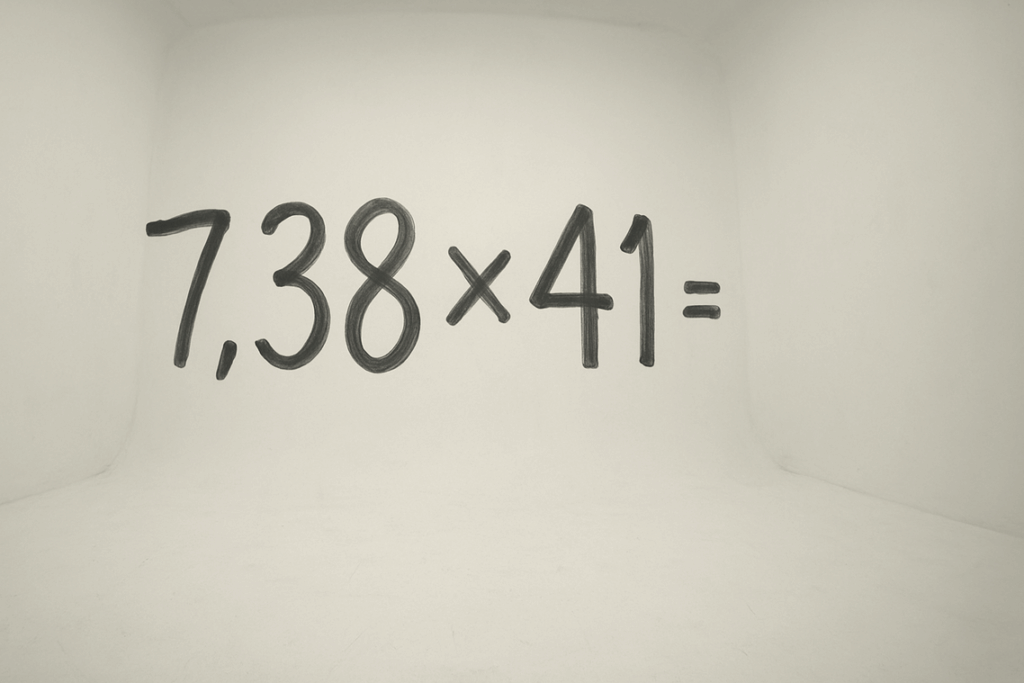
I’m going to show you how to find the multiple of 7.38 x 41 right now.
You searched for this because you need the answer. Maybe it’s for homework, maybe you’re checking your work, or maybe you just want to see the math broken down.
Here’s what you’ll get: the exact answer first, then the step-by-step process so you can do this type of calculation yourself next time.
No complicated explanations. No math jargon that makes your head spin.
Just the straightforward calculation and a simple breakdown of how we got there. You’ll walk away knowing the answer and understanding how multiplication works with decimals.
The Answer and How We Got It: Multiplying 7.38 by 41
The answer is 302.58.
That’s it. If you just needed the number, you’re done.
But maybe you want to know how we got there. Or maybe you’re comparing doing this by hand versus punching it into a calculator.
Let me walk you through both.
The manual method takes a few steps but it’s pretty straightforward once you see the pattern.
First, ignore the decimal. Just multiply 738 by 41 like they’re whole numbers.
Start with 738 times 1. That gives you 738.
Then multiply 738 by 40. You get 29,520.
Add those together and you have 30,258.
Now here’s the part people forget. The original number (7.38) had two decimal places. So you need to put the decimal point two places from the right in your answer.
That gives you 302.58.
The calculator method is obviously faster. You type 7.38×41 and get your answer in a second.
So which approach should you use?
If you’re checking your work or need to understand the math, go manual. It helps you catch mistakes and builds better number sense.
If you’re doing quick calculations (like figuring odds or payouts in technological advancements in casinos ai vr more revolutionizing the gaming experience), use the calculator.
Both get you to the same place. Just depends on what you need in the moment.
Defining Our Terms: What is a ‘Multiple’?
Let me clear something up real quick.
When you see “find the multiple of two numbers,” you’re really just being asked to multiply them together. That’s it.
Take 7.38×41 for example. You multiply those two numbers and you get 302.58. That answer? We call it the product.
Now here’s where people get confused.
The two numbers you started with (7.38 and 41) have a name too. They’re called factors.
Think of it like this. You walk into a casino and see someone betting $7.38 on 41 different spins. The total they’re risking is the product. The bet amount and number of spins are the factors.
Here’s how it breaks down:
- Pick your two numbers (the factors)
- Multiply them together
- The answer you get is the product
I know what some of you are thinking. Isn’t a multiple supposed to be like 5, 10, 15, 20? You know, those clean whole numbers we learned in grade school?
You’re right. That’s how most people use the term. But when someone asks you to find “the multiple” of two specific numbers, they’re asking for something different. They want you to multiply those exact numbers together.
It’s the same operation. Just different context.
The word “multiple” in math class usually means repeated addition of the same number. But in this case, it means the direct product of your two factors.
Makes sense once you see it laid out.
Why This Matters: Practical Uses for Multiplication
You probably don’t think about multiplication much.
But here’s what most people miss. The math you learned in school shows up everywhere, especially when money’s on the line.
Take 7.38×41 as an example.
Financial Calculations
Say you’re buying 41 items at $7.38 each. You need to know the total before you hit checkout. That’s $302.58. Same goes for tracking investment returns over multiple periods.
Project Planning
I’ve seen contractors mess this up all the time. You need 41 pieces of material that are 7.38 meters long. How much total length? If you can’t multiply that in your head (or at least on paper), you’re ordering wrong.
Betting Calculations
This is where it gets interesting.
Most gambling sites don’t spell out your total return. They give you decimal odds and expect you to figure it out. A $41 bet at 7.38 odds means you’re looking at $302.58 coming back if you win.
And yeah, I know what you’re thinking. Can’t you just use a calculator?
Sure. But when you understand the math, you catch mistakes faster. You spot bad odds quicker. You know if the numbers make sense before you commit.
That’s the difference between guessing and knowing.
Tools for a Faster Answer: When to Use a Calculator
Look, I’m not going to tell you to avoid calculators.
That would be ridiculous. We all have phones in our pockets with built-in calculators. Your computer has one too. Most websites offer them for free.
And here’s the truth. When you’re dealing with something like 7.38×41, pulling out a calculator just makes sense. You get your answer fast and you know it’s right.
But some people argue you should always do math by hand. They say calculators make you lazy or that you won’t really understand what you’re doing.
I see where they’re coming from. There’s something to that.
Still, I think they miss the bigger picture. Speed matters. So does accuracy. When you’re working with money or making quick decisions, you can’t afford to mess up because you tried to multiply complex numbers in your head.
That said, knowing how the math actually works? That’s not optional.
When you understand the manual process, you can spot when something looks off. Maybe you hit the wrong button. Maybe the calculator glitched. If you know roughly what the answer should be, you’ll catch it.
Think of it this way. The calculator gets you there faster. But understanding the process keeps you from trusting a wrong answer just because a screen showed it to you.
Use both. That’s my take.
More Than Just a Number
We found the answer you came here for.
7.38 x 41 equals 302.58.
But you got more than just a number. You saw how the process works and why it matters.
The math itself is simple. Multiply these two values and you get your result every time.
Here’s what makes this useful: You can apply this same approach when you’re calculating costs at the store or running numbers for a financial decision. The method stays the same whether you’re working with small purchases or bigger investments.
You came here with a question. Now you have the answer and the understanding to use it.
The calculation is straightforward. The applications are everywhere.